- How Supplements Are Regulated (and Not Regulated)
- How to Read a Supplement Facts Panel
- Proprietary Blends: What They Hide
- Ingredient Research vs. Finished Product Research
- A Quick Example: How to Choose the Best Supplements in Practice
- Certifications and Manufacturing Claims Worth Trusting
- Marketing Red Flags to Watch For
- Guarantees and Return Policies
- How Long to Try a Supplement Before Judging It
- How Review Sites Like This One Work
- Questions to Ask Before You Buy
- How We Review Supplements on This Site
- FAQ
- Related Reading
Learning how to choose the best supplements starts with looking past the marketing on any given sales page, since every one of them says roughly the same things: “clinically proven,” “doctor recommended,” “backed by science.” After reviewing dozens of products across blood sugar, oral health, joint support, hearing, and other categories, we’ve noticed the same handful of evaluation criteria separate the genuinely well-formulated products from the ones riding on marketing alone. This guide lays out that framework, so you can apply it to any supplement, whether or not we’ve reviewed it on this site.
This isn’t a ranking of specific products. For that, see our category guides, like Blood Sugar Support or Oral Health. This is the underlying method behind every one of our reviews, explained once so you can use it yourself.
How Supplements Are Regulated (and Not Regulated)
This is the single most misunderstood part of the supplement industry, and it changes how you should read every claim on every label. In the United States, dietary supplements are regulated under the Dietary Supplement Health and Education Act (DSHEA), which is fundamentally different from how prescription and over-the-counter drugs are regulated.
According to the Office of Dietary Supplements at the National Institutes of Health, manufacturers are responsible for ensuring their products are safe before they go to market, but the FDA does not review or approve dietary supplements for safety or effectiveness before they’re sold, the way it does with drugs. The FDA can take action after a product is on the market if it’s found to be unsafe or mislabeled, but there’s no pre-market approval process comparable to what medications go through.
This is why virtually every supplement sales page includes some version of the disclaimer “these statements have not been evaluated by the Food and Drug Administration.” It’s not boilerplate legal filler, it’s a legally required and accurate statement about how the entire category works. Practically, this means the burden of evaluating a product’s claims falls much more heavily on you as the buyer than it would with a regulated drug.
How to Read a Supplement Facts Panel
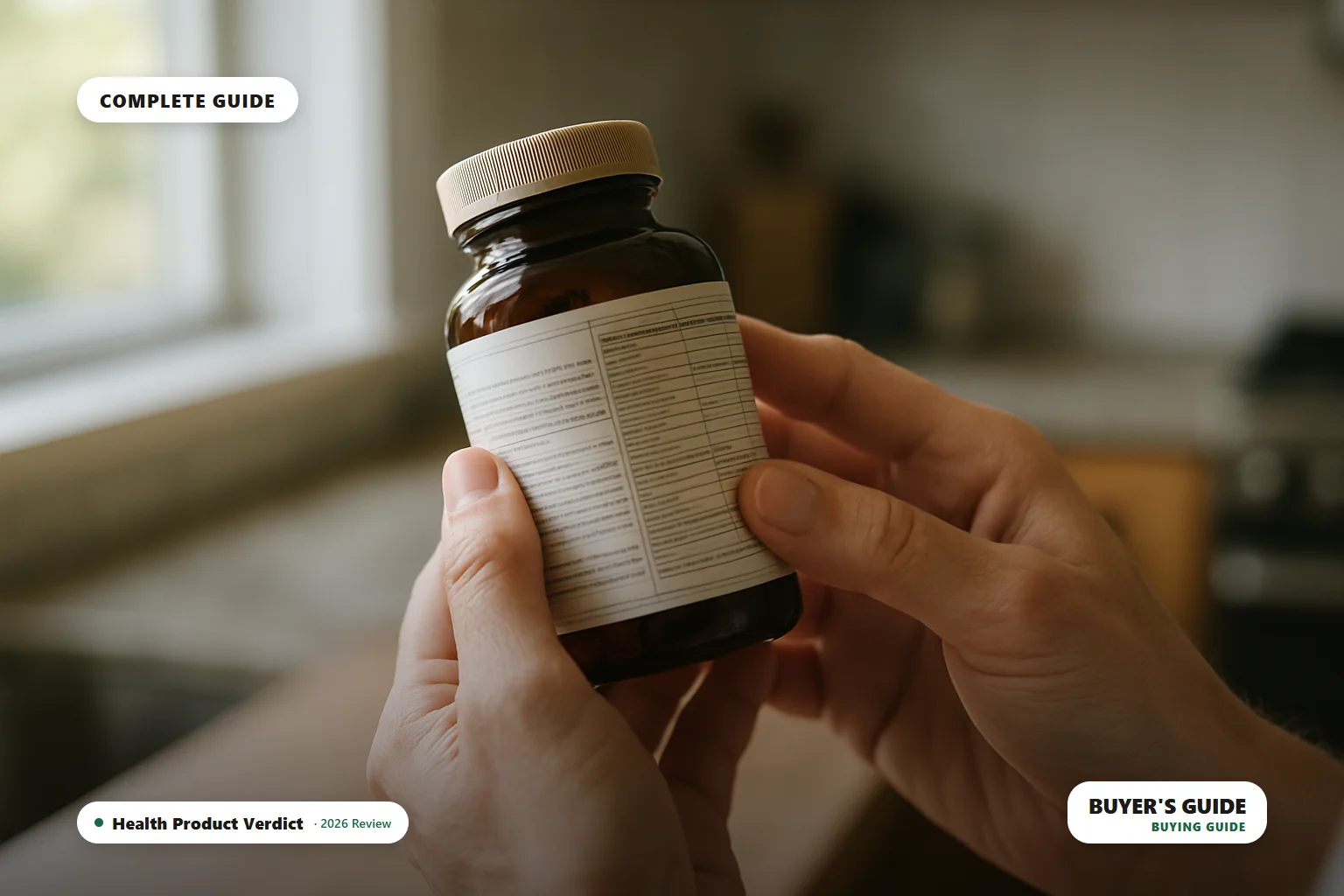
A supplement’s ingredient list can look impressive or vague depending entirely on how it’s disclosed. There are three formats you’ll typically encounter:
- Fully disclosed doses. Each ingredient is listed with its exact amount per serving (e.g. “Chromium 200mcg”). This is the gold standard, since it lets you compare the dose against the amount actually used in the research behind that ingredient.
- Proprietary blend with total weight only. Ingredients are listed by name, but only the combined total weight of the blend is disclosed, not each ingredient’s individual dose. This is extremely common, and not automatically a red flag, but it does mean you’re trusting the manufacturer’s formulation decisions rather than being able to verify them yourself.
- Vague amounts with no panel at all. Some sales pages describe ingredients in prose without ever showing an actual supplement facts panel. This is the format that deserves the most skepticism, since it usually means you won’t see real dosage information until after you’ve already purchased the product.
In every review on this site, we note which of these three formats applies, and we flag it explicitly as a con when a product relies on the third, no-panel format.
Proprietary Blends: What They Hide
Proprietary blends deserve a closer look because they’re the norm, not the exception, across this entire industry. A blend might list six ingredients and a combined total of “750mg,” but that tells you nothing about whether the most clinically-relevant ingredient makes up 700mg of that total or 20mg of it. Manufacturers sometimes list ingredients in descending order by weight (a common convention, though not always followed), which can give you a rough sense of what dominates the formula, but it’s not a substitute for exact numbers.
The practical takeaway: a proprietary blend isn’t disqualifying on its own, since there are legitimate business reasons a company might not want to publish its exact formula (competitors copying it is a real concern in this industry). But it does mean you can’t fully verify the dosing yourself, and that’s a real trade-off worth weighing against everything else the product has going for it.
Ingredient Research vs. Finished Product Research
This is the distinction that trips up more supplement research than any other. There’s a real difference between “this ingredient has been studied” and “this specific product has been studied.” Most supplements in this space use ingredients that individually have genuine published research behind them, sometimes going back decades. Far fewer products have had the complete, finished formula, at the exact doses and combinations that specific brand uses, tested in its own clinical trial.
This doesn’t mean the product is worthless. If a formula combines several individually well-researched ingredients at reasonable doses, that’s a legitimate, evidence-informed approach, just not the same thing as a trial on the finished product itself. We draw this distinction explicitly in every review we publish, because sales pages routinely blur it, citing a study on one ingredient in a way that implies the whole product was tested.
A Quick Example: How to Choose the Best Supplements in Practice
Say you’re comparing two hypothetical joint-support supplements. Product A lists “Proprietary Joint Blend, 500mg” with six ingredient names underneath and no individual doses. Product B lists each of five ingredients with an exact milligram amount, cites a specific published study for its two lead ingredients at comparable doses to what it uses, names its manufacturer with a real address, and offers a 90-day guarantee. Product A offers a 30-day guarantee and doesn’t name a manufacturer anywhere on the page.
Neither product is necessarily bad. Product A might still contain genuinely useful ingredients. But Product B gives you meaningfully more information to evaluate before you spend money, and a longer window to change your mind if it doesn’t work for you. Applied consistently, this is the exact comparison we run for every review on this site, and it’s the same comparison you can run yourself on any product, in any category, using nothing but the sales page in front of you.
Certifications and Manufacturing Claims Worth Trusting
Not all quality claims carry equal weight. A few worth knowing:
- GMP certified (Good Manufacturing Practices). A real, meaningful standard covering manufacturing consistency, cleanliness, and quality control. Look for it to be tied to a specific certifying body rather than just claimed in prose.
- FDA-registered facility. This means the facility is registered with the FDA, which is a baseline requirement for manufacturers, not an endorsement of the product itself. It’s often phrased in marketing in a way that implies more oversight than it actually represents.
- Third-party tested. Ideally means an independent lab verified the product actually contains what the label claims, at the stated purity. Worth more when the brand names the specific lab or shows a certificate of analysis, rather than just stating it happened.
- Non-GMO, gluten-free, vegan, etc. Legitimate dietary claims, but unrelated to whether the product actually works for its stated purpose. Useful for personal dietary restrictions, not a signal of efficacy.
Marketing Red Flags to Watch For
Across the dozens of products we’ve reviewed, the same handful of marketing tactics come up repeatedly. None of them automatically mean a product is bad, but they all warrant reading more carefully rather than buying on impulse.
- Artificial urgency. “Stock running out,” “price goes up when you leave this page,” or countdown timers that reset when you revisit. These are conversion tactics, not genuine supply signals, and we call them out directly when we see them.
- Conspiracy framing. Claims that “Big Pharma” or “the medical establishment” is suppressing the product. This is a persuasion technique, not evidence, and it should make you more skeptical of the surrounding claims, not less.
- Vague “doctor recommended” claims. Without a named doctor, credentials, or a way to verify the claim, this is unverifiable marketing language.
- Before-and-after photos or testimonials as the primary evidence. Individual anecdotes aren’t a substitute for research on the ingredients or the product, even when they’re presented as “real customer results.”
- Miracle framing around a single mechanism. Real physiology is rarely as simple as “one root cause” for a complex health condition. Be cautious of formulas built around a single discovery framed as the answer to a broad category of symptoms.
Guarantees and Return Policies
A money-back guarantee is one of the more genuinely useful signals available to you as a buyer, since it directly affects your financial risk. Guarantee windows across the products we’ve reviewed typically range from 60 to 180 days. A longer window gives you more time to fairly evaluate whether a product is working, particularly for supplements where effects build gradually over weeks rather than appearing immediately.
Read the fine print on any guarantee: does it require returning empty bottles, or does it cover opened and used product? Is it a full refund or store credit? Does it apply to every package size, or only the largest one? These details vary meaningfully between brands and are worth checking before you buy, not after you’re trying to get a refund.
How Long to Try a Supplement Before Judging It
One of the most common ways people misjudge a supplement, in either direction, is timeline. Very few supplement ingredients produce an effect within days, the way a fast-acting medication might. Most of the clinical trials behind ingredients covered across our reviews ran somewhere between six and twelve weeks, and several of the strongest results, particularly for probiotic and metabolic ingredients, only became apparent after two months or more of consistent daily use.
This cuts both ways. If you stop after a week because you don’t feel anything, you may be abandoning a product before it had a realistic chance to work. On the other hand, if a product’s own money-back guarantee window is shorter than the timeline its own cited research used, that’s a genuine mismatch worth noticing, since it means you may run out of time to fairly judge results before you lose the ability to get a refund.
How Review Sites Like This One Work
It’s worth understanding the business model behind sites like this one, since it affects how you should read any review, including ours. When you click through to a product’s official website from one of our reviews and make a purchase, we may earn a commission from the sale, at no additional cost to you. This is standard for the affiliate review model, and it’s disclosed on every relevant page of this site.
Knowing this, here’s what to look for in any review site, including this one: does it disclose ingredients honestly, including gaps in disclosure or evidence, or does it only ever say positive things? Does it flag manipulative marketing tactics on the sales pages it links to, even though doing so arguably works against its own short-term interest in you clicking through? Does the scoring methodology stay consistent across products, or does it seem to shift depending on which product is being covered? A review site with a genuine editorial standard will apply the same scrutiny to every product it covers, commission or not.
Questions to Ask Before You Buy
A practical checklist, distilled from everything above:
- Does the product disclose individual ingredient doses, or only a total blend weight?
- Do the named ingredients have independent, published research behind their role in this specific health area?
- Has the finished product itself been tested, or only its individual ingredients?
- Is the manufacturer identifiable, with a real name and address, or hidden behind the sales page alone?
- How long is the money-back guarantee, and what does it actually cover?
- Does the marketing rely on urgency, conspiracy framing, or unverifiable endorsements more than it relies on explaining the ingredients?
- If you have a medical condition or take medication, have you checked with your doctor about potential interactions?
How We Review Supplements on This Site
Every review published on Health Product Verdict is scored against the same five criteria, so comparisons within a category are apples-to-apples rather than each product grading itself against its own marketing:
- Ingredient quality: whether named ingredients have real, independent research behind their role in the relevant health area.
- Scientific evidence: whether the finished product itself has been separately tested, and how the ingredient-level research compares to product-level claims.
- Value for money: price per bottle at the best available package, weighed against the guarantee length and what’s actually in the formula.
- Customer reviews: patterns across available customer feedback, weighed as one input among several, not the primary evidence.
- Manufacturer trust: whether the company discloses who they are, where the product is made, and what quality standards they follow.
We also apply a strict anti-invention rule: we never invent ingredients, mechanisms, benefits, studies, or numbers that aren’t actually present on the source sales page or in real published research. If information isn’t available, we say so directly in the review rather than filling the gap with something that sounds plausible.
FAQ
Does “FDA registered” mean a supplement is FDA approved?
No. FDA registration of a manufacturing facility is a baseline regulatory requirement, not an endorsement or approval of the specific product. The FDA does not approve dietary supplements before they go to market the way it does with prescription drugs.
Are proprietary blends always a bad sign?
Not automatically. They’re extremely common across the entire supplement industry, and there are legitimate reasons a company might not disclose its exact formula. The real drawback is that you can’t independently verify individual ingredient doses, which matters more for some ingredients (where an underdose makes an ingredient functionally useless) than others.
How do I know if a supplement is safe to combine with my medication?
Ask your doctor or pharmacist directly, ideally by bringing the actual ingredient list with you. Several common supplement ingredients (blood-sugar-lowering herbs, blood-thinning enzymes, and others) can interact meaningfully with prescription medication, and this isn’t something to determine from a sales page alone.
Why do supplement prices drop so much when you buy multiple bottles?
Bulk pricing is a genuine industry norm reflecting real per-unit savings, but it’s also a deliberate incentive to get you to commit to a longer supply before you’ve confirmed the product works for you. Consider starting with a smaller package if you’re trying a product for the first time, unless the guarantee window is long enough to make the larger package effectively risk-free.
What’s the single most useful thing to check before buying any supplement?
Whether the ingredients are individually disclosed with real doses, and whether those doses are in the range actually used in the research behind each ingredient. This one check filters out more weak products than any other single factor.
Related Reading
- Blood Sugar Support: The Complete Guide
- Oral Health: The Complete Guide
- Joint and Muscle Pain: The Complete Guide
- Digestive Comfort: The Complete Guide
- Prostate Health: The Complete Guide
- Hearing Support: The Complete Guide
- Weight Loss and Metabolism: The Complete Guide
- Skin Aging: The Complete Guide
- Sleep Support: The Complete Guide
- Nerve Pain Relief: The Complete Guide
- Brain Fog and Memory: The Complete Guide
- Vertigo and Dizziness: The Complete Guide
- Eye Health and Vision Strain: The Complete Guide
- Low Energy and Fatigue: The Complete Guide
- Bladder Control: The Complete Guide
- Nail Fungus Treatment: The Complete Guide
- Best Blood Sugar Supplements 2026
- Best Oral Health Supplements 2026
Health Product Verdict provides independent analysis and reviews of health-related products. Our content is for informational purposes only and does not constitute medical advice. Always consult a qualified healthcare professional before starting any supplement or health program.