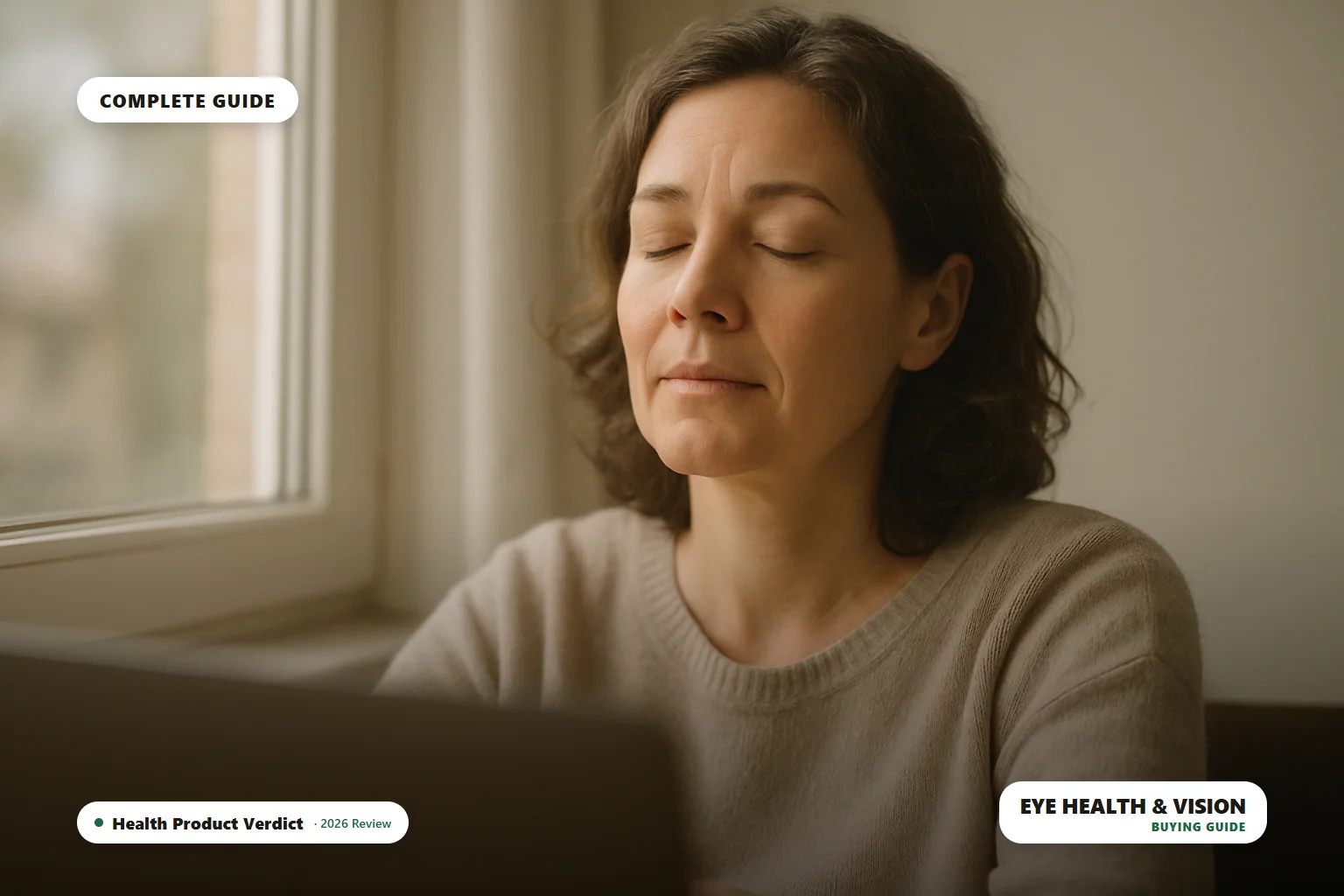
Tired, dry, or blurry eyes after a long day on screens, plus worries about vision changes as you age, lead a lot of people to consider eye health supplements. This guide gives you an honest answer: what eye strain and age-related vision changes really are, why they happen, the habits that protect your sight, when to see an eye doctor, and how the vision-support products we have reviewed genuinely compare.
Quick answer: most everyday eye strain comes from screens, dryness, and needing an updated glasses prescription, not a nutrient deficiency. No supplement restores lost vision. A few well-researched nutrients, like lutein, zeaxanthin, and the antioxidants studied in the AREDS research, may support long-term eye health, while regular eye exams and screen habits do the most day to day.
What Is Eye Strain?
Digital eye strain, sometimes called computer vision syndrome, is temporary discomfort from prolonged screen use: tired, dry, or achy eyes, blurred vision, and sometimes headaches. According to the National Eye Institute (NEI), many vision problems can be prevented or slowed with regular comprehensive eye exams and healthy habits, and some age-related eye conditions are influenced by nutrition and lifestyle.
Eye strain itself is uncomfortable but does not cause permanent damage on its own. It happens because we blink less and focus at a fixed close distance when we stare at screens, which tires the eye’s focusing muscles and dries the surface. It usually eases with rest, blinking, and a change of focus, which is why the fix is behavioral rather than nutritional.
Age-related vision changes are a separate story. Presbyopia (needing reading glasses), cataracts, and age-related macular degeneration (AMD) develop over years. Nutrition plays a role in some of these, most notably AMD, where specific antioxidant formulas have research behind them, but supplements support eye health rather than reverse established vision loss. Keeping these two categories separate, temporary strain versus long-term change, is the key to spending your money wisely.
Common Signs
Common eye complaints fall into a few groups, and telling them apart helps you decide whether you need a break, an eye exam, or something more:
- Tired, dry, or gritty eyes after screens or reading, often with a burning feeling.
- Blurred vision that improves with rest or blinking, a hallmark of strain rather than disease.
- Headaches around the eyes or forehead after close work.
- Difficulty switching focus between near and far, which becomes common with age (presbyopia).
- Sensitivity to light or trouble seeing at night, which can have many causes and is worth mentioning to an eye doctor.
- Watery eyes, which paradoxically often signal dryness as the eyes over-compensate.
The reassuring pattern is that strain-related symptoms come and go with screen use and rest. Symptoms that are constant, one-sided, or getting steadily worse are the ones that deserve professional attention rather than a supplement.
When to See an Eye Doctor
Occasional strain that eases with rest is normal. But some changes need an eye doctor rather than a supplement: sudden vision loss or blurring, flashes of light or a shower of new floaters, a curtain or shadow moving across your vision, eye pain, or any noticeable, persistent decline in sight. These can signal urgent problems such as retinal issues and should be checked promptly.
Just as importantly, regular comprehensive eye exams catch conditions like glaucoma and macular degeneration early, when they are most treatable, often before you notice any symptoms. That early detection is something no supplement can do, and it is the single most valuable thing you can do for your long-term vision, especially as you get older or if eye disease runs in your family.
Common Myths About Eye Supplements
Myth: “A supplement can restore my eyesight.” No supplement reverses lost vision or replaces glasses. Some nutrients support long-term eye health, but they do not sharpen a prescription or undo damage.
Myth: “Eye strain from screens causes permanent damage.” Digital eye strain is temporary and does not cause lasting harm, though it is well worth managing for comfort.
Myth: “Carrots, or any single food, will fix my vision.” Vitamin A matters for eye health, but most people already get enough, and no single food corrects refractive errors like short- or long-sightedness.
Myth: “If a formula names AREDS ingredients, it matches the research.” Many products borrow the ingredient names without matching the studied doses, so the label alone does not guarantee the researched benefit.
Habits That Protect Your Vision
For comfortable, healthy eyes, habits do the heavy lifting, and most cost nothing:
- Follow the 20-20-20 rule: every 20 minutes, look at something 20 feet away for 20 seconds to relax the focusing muscles.
- Blink often and use artificial tears if screens leave your eyes dry.
- Get regular eye exams and keep your glasses or contacts prescription current, since an outdated prescription is a common cause of strain and headaches.
- Wear UV-blocking sunglasses, because cumulative sun exposure affects long-term eye health and cataract risk.
- Eat for your eyes, with leafy greens and colorful vegetables rich in lutein and zeaxanthin.
- Set up your screen well, at arm’s length and slightly below eye level, with good lighting to reduce glare.
These habits address the actual causes of most day-to-day eye complaints, which is exactly why they outperform any capsule for comfort. A supplement makes the most sense as long-term support for eye health, layered on top of good habits and regular exams, not as a substitute for them.
Do Eye Health Supplements Actually Work?
Most eye health supplements supply antioxidants and nutrients concentrated in the retina and lens. The best-known research is the AREDS and AREDS2 studies, which found that a specific formula of vitamins C and E, zinc, copper, lutein, and zeaxanthin slowed progression in people who already had intermediate age-related macular degeneration.
So do they work? For that specific group and that specific formula, yes, there is real evidence. The important nuance is that this benefit applies to a particular condition, not to general “better eyesight” for everyone. For a healthy adult with tired eyes from screens, an eye supplement is unlikely to do much that good habits and an updated prescription would not do better.
That is why it pays to check the label against the actual research. Many eye supplements borrow the AREDS ingredient names without matching the studied doses, and a proprietary blend can hide whether the useful amounts are really there. When you compare eye health supplements, a formula whose lutein and zeaxanthin doses resemble the research is a far better sign than a long list of trendy extracts.
Ingredients Worth Knowing
carotenoids that concentrate in the retina and are central to the AREDS2 eye-health research.
the antioxidant and mineral backbone of the AREDS formulas for macular health.
a structural fat in the retina, often included, with mixed evidence for dry eye and AMD.
antioxidant plant compounds popular in eye blends, with limited but suggestive research.
essential for vision, though most people get enough from diet, and smokers should avoid high-dose beta-carotene.
The theme here is that a few researched nutrients at meaningful doses matter far more than a long, exotic-sounding list. If you have early macular changes, matching the AREDS2 amounts is the goal; if you simply have tired eyes, most of these will not move the needle much.
Screens, Aging, and Your Eyes
Two very different forces drive most of the eye complaints people bring to a supplement search: screens and time. Screens cause temporary, mechanical strain. When you stare at a display, you blink far less than normal, hold your focus at one close distance for hours, and often fight glare, all of which tire the focusing muscles and dry the eye’s surface. This is uncomfortable and can cause headaches, but it clears with rest and better habits, and no capsule speeds that up.
Aging is the slower force. From your forties, the lens gradually stiffens, making close focus harder (presbyopia), which is why reading glasses become near-universal. Over decades, cumulative sun exposure, oxidative stress, and genetics influence conditions like cataracts and macular degeneration. This is the arena where nutrition has a genuine, if limited, role, because a handful of antioxidants are concentrated in the retina and may support its long-term health.
Separating these two forces is the key to spending wisely. If your problem is tired eyes at 5 p.m., the fix is behavioral, breaks, blinking, an updated prescription, not a bottle. If your concern is protecting aging eyes over years, that is where a well-chosen eye health supplement, alongside exams and sun protection, can play a supporting part.
What the AREDS Research Actually Found
Almost every eye supplement borrows its credibility from the AREDS and AREDS2 studies, so it is worth knowing what they really showed. These large, long-term trials tested a specific combination, vitamins C and E, zinc, copper, and later lutein and zeaxanthin, in people who already had intermediate or advanced age-related macular degeneration in at least one eye. In that group, the formula modestly slowed progression to more advanced disease.
What the studies did not show is just as important. They did not find that the formula prevents macular degeneration in healthy eyes, improves vision in people without the disease, or sharpens eyesight generally. In other words, the evidence is real but narrow: a particular formula, for a particular condition, to slow progression, not a general “vision booster” for everyone. When a product invokes AREDS, the fair question is whether its doses actually match the research, and whether you are in the group the research applies to.
Do Blue-Light Glasses and Supplements Help?
Blue light from screens gets blamed for a lot of eye strain, but the research on it is more limited than the marketing suggests. Blue-light-filtering glasses and blue-light-specific supplements are popular, yet good-quality evidence that they reduce digital eye strain or protect the retina in everyday screen users is thin. Most of what people label “blue light strain” is better explained by reduced blinking, fixed close focus, and screen glare, all of which respond to behavioral fixes rather than filtering.
That does not mean blue light is irrelevant to eye health in every sense, evening blue-light exposure can affect sleep by suppressing melatonin, which is a separate issue from eye strain itself. If you struggle to wind down after evening screen use, dimming displays or using a warmer color setting at night may help your sleep more than your eyes specifically.
For daytime screen discomfort, the evidence still points to the basics: the 20-20-20 rule, blinking, good lighting, and an updated prescription. Treat blue-light products as a possible minor comfort measure at most, not a proven solution, and put your money and effort into the habits with stronger backing first.
Children, Screens, and Developing Eyes
Parents often ask whether kids need eye supplements given how much time they spend on screens, and it is worth addressing directly. Children’s eyes are still developing, and there is genuine research interest in rising rates of myopia (nearsightedness) in young people, which some researchers link partly to less time spent outdoors and more time on close-up screen work.
The strongest evidence-backed intervention for childhood myopia risk is not a supplement, it is time spent outdoors in natural light, which several studies associate with slower myopia progression. Alongside that, sensible screen breaks, good lighting, and appropriately sized text for the child’s age matter more than any product marketed for kids’ eye health.
If a child has genuine vision concerns, blurry board vision, squinting, headaches, or difficulty at school, a pediatric eye exam is the right next step, not a supplement. As with adults, exams catch treatable problems early; nutrition supports overall health but does not substitute for that professional check.
How We Evaluate These Products
Every eye-health supplement we review is scored on the same five factors, so the comparison below is consistent: ingredient quality, scientific evidence, value for money (price and guarantee), customer feedback, and manufacturer trust (dose transparency and honest marketing). We read the real sales page and label for each product and never invent ingredients, studies, or results, and a formula that names AREDS ingredients but hides the doses is marked down accordingly.
Comparing Every Product We’ve Reviewed
Here is how the eye-health products we have reviewed compare. Click any name for the full, detailed review.
| Product | Score | Format | Best For | Guarantee |
| Vision 20 | 8.1/10 | Capsule | Those wanting the highest-scoring option with a long guarantee | 180-Day |
| iGenics | 6.8/10 | Capsule | Those exploring a broad vision-support blend | Check current offer |
| VisiFlora | 6.7/10 | Capsule | Those wanting an AREDS2-aligned formula with extra antioxidants | 60-Day |
Vision 20 earns the higher score on a more transparent, better-guaranteed formula. iGenics and VisiFlora land close behind, with VisiFlora’s core ingredients tracking the AREDS2 research more closely, though neither discloses doses as clearly as Vision 20. None of the three replaces an eye exam or an updated prescription.
How to Choose the Right One
Start with an eye exam, which does far more than any supplement and catches treatable conditions early. If you want to add a product, and especially if you have early macular changes, look for one whose lutein and zeaxanthin doses resemble the AREDS2 research, favor transparent labels over vague blends, and choose a longer guarantee to lower your risk.
Keep expectations realistic. The better eye health supplements support long-term eye health over months and years; none sharpens vision like a new pair of glasses. If your main issue is screen fatigue, the 20-20-20 rule and artificial tears will help more than any bottle. Among the options above, the higher-scoring product simply pairs a clearer formula with a stronger guarantee.
FAQ
Can supplements improve my eyesight?
No supplement sharpens vision or replaces glasses. Certain nutrients support long-term eye health, most clearly for age-related macular degeneration, but they do not restore lost sight.
Which nutrients have the best eye-health evidence?
Lutein, zeaxanthin, and the AREDS2 antioxidant-and-zinc formula have the strongest research, specifically for slowing intermediate macular degeneration.
Is screen eye strain permanent?
No. Digital eye strain is temporary and does not cause lasting damage, though the 20-20-20 rule and artificial tears help with comfort.
When should I see an eye doctor urgently?
Sudden vision loss, flashes, a burst of new floaters, a shadow across your vision, or eye pain need prompt attention.
Do I need eye supplements if my diet is good?
Often not. A diet rich in leafy greens and colorful vegetables provides lutein and zeaxanthin. Supplements matter most for specific conditions like AMD.
How often should I get an eye exam?
Follow your eye doctor’s advice, but regular comprehensive exams are the single most valuable thing you can do for long-term eye health.
Related Reading
- Do Blue Light Glasses Actually Work for Eye Strain?
- Why Is My Vision Blurry After Eating?
- How to Choose the Best Supplements: A Buyer’s Guide
- Vision Changes and Eye Strain: Causes and What Helps
- Vision 20 Review
- iGenics Review
- VisiFlora Review
Health Product Verdict provides independent analysis and reviews of health-related products. Our content is for informational purposes only and does not constitute medical advice. Vision changes can signal treatable conditions, so always consult a qualified eye-care professional for exams, diagnosis, and treatment.