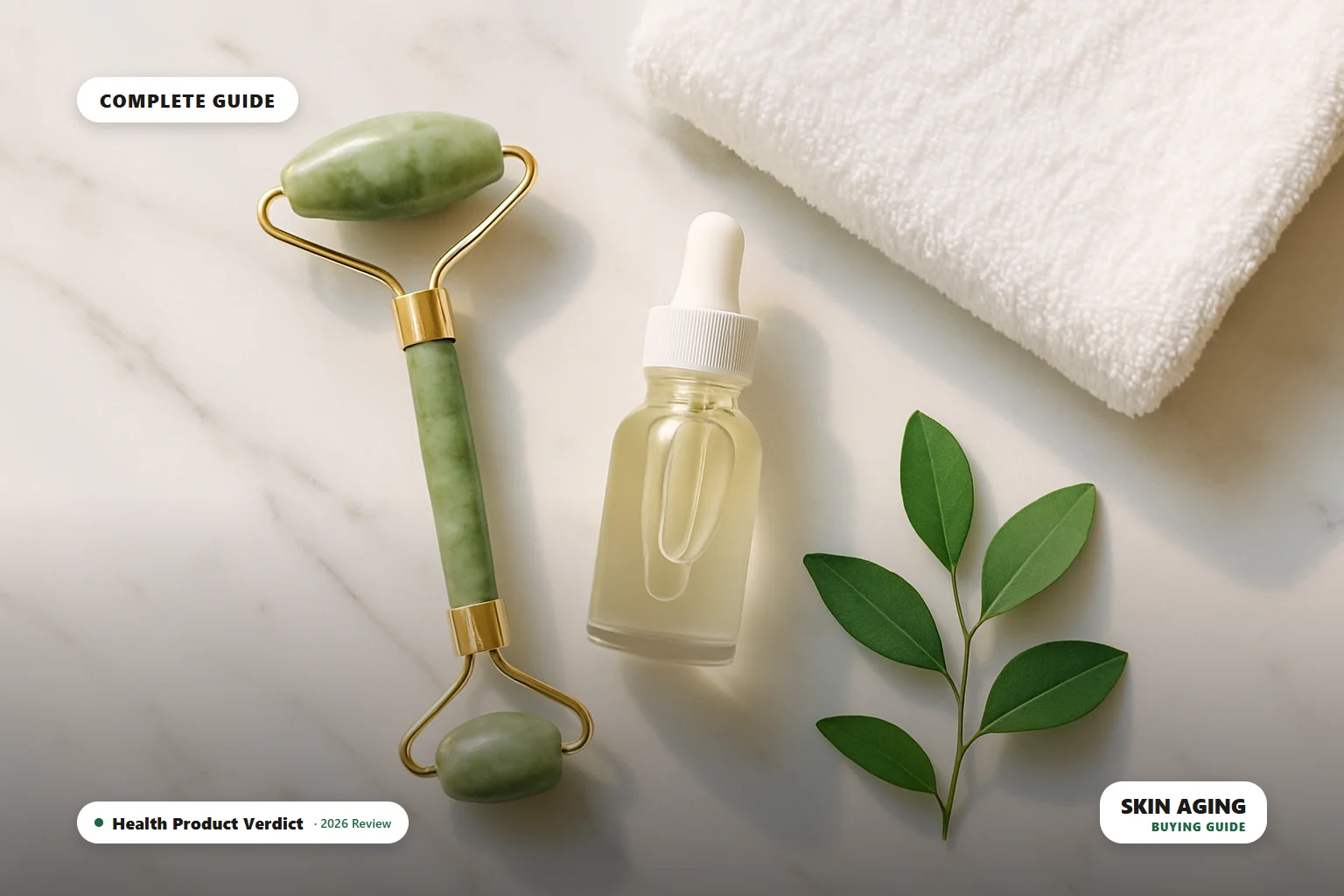
Skin aging is something every adult eventually notices, whether it shows up as a fine line near the eyes, a dark spot on the cheek, or skin that feels a little less firm than it used to. This guide walks through what actually causes skin aging, which signs are normal versus worth a dermatologist visit, and how the topical serums and oral supplements we’ve reviewed compare to one another.
Quick answer: skin aging is driven by two overlapping processes, intrinsic aging (genetics and the natural slowdown of collagen production over time) and extrinsic aging (sun exposure, pollution, and lifestyle factors). No single product reverses either process completely, but consistent sun protection, hydration, and a small number of well-researched ingredients can visibly slow how fine lines, dark spots, and loss of firmness progress.
- What Is Skin Aging?
- Common Signs of Skin Aging
- When to See a Dermatologist
- Common Myths About Anti-Aging Products
- Daily Habits That Matter More Than Any Product
- How Skin Aging Products Work
- Ingredients Worth Knowing
- How We Evaluate These Products
- Comparing Every Product We’ve Reviewed
- How to Choose the Right One
- FAQ
What Is Skin Aging?
According to the American Academy of Dermatology, dermatology research generally splits skin aging into two categories that happen at the same time, at different rates, for different reasons.
Intrinsic aging is the natural, genetically programmed process that happens regardless of environment. Collagen and elastin production, the two proteins that keep skin firm and elastic, gradually slow down starting in a person’s mid-to-late twenties. Cell turnover also slows, which is part of why skin can start to look duller or more textured with age.
Extrinsic aging is caused by outside factors, and it is responsible for the majority of visible skin aging most people notice. Cumulative sun exposure (UV damage, often called photoaging) is the single largest contributor, followed by pollution, smoking, poor sleep, high sugar intake, and repetitive facial expressions. This is also the part of skin aging people have the most control over.
Hormonal changes also play a real role in intrinsic skin aging, particularly for women going through menopause. Declining estrogen is associated with reduced collagen production and slower wound healing, which is one reason skin changes can feel more noticeable during this life stage. Genetics set the baseline pace for all of this, which is why two people with similar sun exposure and habits can still age visibly differently.
Common Signs of Skin Aging
Most people notice one or more of these changes first, often starting around the eyes, forehead, and cheeks, which see the most sun exposure and expression movement over a lifetime:
- Fine lines and wrinkles, especially around the eyes (often called crow’s feet), forehead, and mouth.
- Dark spots and uneven pigmentation, sometimes called age spots or sun spots, caused by years of cumulative UV exposure triggering excess melanin production in localized areas.
- Loss of firmness and elasticity, which can make skin appear to sag slightly, particularly along the jawline and cheeks.
- Dullness and uneven texture, a result of slower cell turnover leaving more dead skin cells on the surface than in younger skin.
- Dryness, since oil production also tends to decrease with age, which can make fine lines more visible.
When to See a Dermatologist
Gradual fine lines, mild dark spots, and slowly changing firmness are a normal part of skin aging and are not, by themselves, a reason to see a doctor. A few specific changes are worth a dermatologist visit rather than a new serum, however: any mole or dark spot that changes shape, size, or color rapidly, a spot that bleeds, itches, or won’t heal, sudden or severe skin changes, or persistent redness and irritation that a product may be making worse rather than better. A dermatologist can also rule out other causes, like hormonal changes, medication side effects, or nutrient deficiencies, before you spend money on a supplement or serum aimed at a purely cosmetic concern.
Common Myths About Anti-Aging Products
Myth: A serum or supplement can “reverse” skin aging. No topical or oral product reverses the underlying biological process. The realistic claim, and the one worth looking for on a sales page, is supporting hydration, antioxidant protection, or collagen production, which can visibly improve the appearance of fine lines and firmness over weeks to months, not undo years of sun damage overnight.
Myth: More expensive always means more effective. Price is set by marketing, packaging, and brand positioning as much as by ingredient quality. A handful of well-researched ingredients (vitamin C, hyaluronic acid, and sunscreen, most consistently) do more documented work than most proprietary blends, regardless of price point.
Myth: Oral collagen and topical serums do the same job. They don’t, and they aren’t interchangeable. Topical products work at the skin’s surface and support hydration and antioxidant protection directly where applied. Oral formulas (collagen powders, gut-health probiotics) work systemically, on the theory that supporting collagen synthesis or gut microbiome balance from the inside can influence skin appearance more broadly. Some people use one, others use both together.
Daily Habits That Matter More Than Any Product
Before adding any serum or supplement, the habits below have the strongest, most consistent evidence behind them for slowing visible skin aging:
- Daily sunscreen, even on cloudy days. Cumulative UV exposure is the single biggest driver of extrinsic skin aging. Broad-spectrum SPF 30 or higher, applied daily, is the most evidence-backed anti-aging habit that exists.
- Consistent hydration, both from drinking enough water and from using a moisturizer suited to your skin type.
- Adequate sleep. Skin repair processes are more active during sleep, and chronic sleep deprivation is associated with reduced skin barrier function.
- Limiting added sugar. A process called glycation, where sugar molecules bind to collagen and elastin, is thought to make skin fibers stiffer and less elastic over time.
- Not smoking, since smoking measurably accelerates collagen breakdown and reduces blood flow to skin.
How Skin Aging Products Work
Products in this category generally take one of three approaches. Topical antioxidant serums, like Illuderma and Hydrossential, are applied directly to skin and combine ingredients like vitamin C, hyaluronic acid, and botanical extracts to support hydration and reduce the visible appearance of dark spots and fine lines at the surface. Oral collagen formulas, like Advanced Collagen Plus, take a different route, supplying collagen peptides from food sources on the theory that supporting the body’s own collagen supply from the inside can improve skin firmness and elasticity over time. Gut-skin formulas, like PrimeBiome, take a third angle entirely, using probiotic strains and prebiotic fiber on the theory that gut microbiome balance can influence skin appearance, an area of ongoing but still fairly early research.
None of these approaches work as fast or as dramatically as in-office treatments like retinoid prescriptions, chemical peels, or laser resurfacing. The realistic expectation for any serum or supplement in this category is gradual, visible improvement over 8-12 weeks of consistent use, not an overnight transformation.
The Gut-Skin Connection: What the Research Actually Shows
The idea that gut health influences skin appearance is not new in wellness circles, but the scientific research behind it is still fairly early compared to well-established topical ingredients like vitamin C or hyaluronic acid. The theory centers on the gut microbiome, the community of bacteria living in the digestive tract, and its role in inflammation. Since chronic low-grade inflammation is linked to several skin concerns, including premature aging and breakouts, some researchers hypothesize that a more balanced gut microbiome could indirectly support clearer, more resilient skin.
This is a genuinely different mechanism than a topical serum or an oral collagen supplement, and it’s worth understanding as a distinct category rather than assuming it works the same way. Probiotic strains like Bacillus Coagulans, paired with prebiotic fiber, are the most common approach in gut-skin formulas. The honest caveat: most of the specific skin-appearance claims made by products in this category are extrapolated from broader gut-health research rather than from clinical trials on the finished skin-focused formula itself. That doesn’t mean the mechanism is invalid, but it does mean expectations should stay realistic and the ingredient list should be evaluated on its own merits rather than the marketing framing.
Ingredients Worth Knowing
A well-documented topical antioxidant, widely studied for supporting a brighter, more even-toned complexion and helping defend against environmental damage. Featured in Illuderma.
One of the most consistently researched hydrating ingredients in skincare, valued for its ability to help skin hold onto moisture, which can make fine lines appear less pronounced. Featured in Illuderma.
A trio of widely used botanical skincare staples for hydrating, moisturizing, and toning skin. All three appear in both Illuderma and Hydrossential’s formulas.
Collagen decline is a documented root cause of fine lines and reduced firmness. Oral collagen peptide supplements, sourced from bovine, marine, poultry, or eggshell membrane, are studied for supporting the body’s own collagen levels from the inside. Featured in Advanced Collagen Plus, which combines five collagen types from four sources.
A spore-forming probiotic strain paired with inulin, a prebiotic fiber, on the theory that gut microbiome balance may influence skin appearance. This is a newer and less established mechanism than topical antioxidants or oral collagen, worth knowing before expecting the same kind of results. Featured in PrimeBiome.
Reading Labels in This Category
Skin aging products are a category where proprietary blends are common, especially on topical serums, meaning a manufacturer lists which ingredients are included without disclosing the exact concentration of each. This isn’t automatically a red flag (cosmetic formulas often protect specific ratios for competitive reasons), but it does mean you’re trusting the brand’s formulation more than you would with a fully disclosed label. A few things worth checking before ordering: whether the product is manufactured in a GMP-certified facility, whether it discloses common allergens, whether the guarantee period is long enough to actually judge results (60-90 days, based on the products in this comparison), and whether the sales page cites any research at all versus relying purely on before-and-after marketing language.
How We Evaluate These Products
For every product in this comparison, we read the official sales page, the full ingredient list where disclosed, the guarantee terms, and the FAQ section before writing a review. Where a manufacturer does not publish specific details, such as exact ingredient concentrations or clinical trial data on the finished formula, we say so directly rather than filling in the gap ourselves. Scores reflect ingredient transparency, the strength of research behind the named ingredients, manufacturing standards (GMP certification, non-GMO status, allergen disclosures), guarantee length, and overall value, not marketing claims on the sales page.
Comparing Every Product We’ve Reviewed
We’ve reviewed four skin aging products in depth, spanning topical serums, an oral collagen powder, and a gut-skin gummy. Here’s an honest side-by-side, based on our full reviews of each.
| Product | Score | Format | Best For | Guarantee |
| Advanced Collagen Plus | 8.2/10 | Oral powder | Adults wanting the highest-scoring option, addressing collagen decline from the inside | 90-Day |
| PrimeBiome | 7.8/10 | Gummy | Adults wanting a gut-skin, probiotic-based approach | 60-Day |
| Illuderma | 7.2/10 | Topical serum | Adults specifically targeting dark spots and uneven tone | 60-Day |
| Hydrossential | 6.7/10 | Topical serum | Adults wanting a simpler, hydration-focused serum | 60-Day |
How to Choose the Right One
- Want to address collagen decline from the inside? Advanced Collagen Plus is the only oral collagen formula in this comparison, and it scored highest overall.
- Want a gut-microbiome-focused approach? PrimeBiome is the only product here built around probiotic strains rather than topical or collagen ingredients.
- Specifically targeting dark spots? Illuderma’s ingredient list leans most heavily toward brightening and even-tone ingredients like vitamin C.
- Want the simplest, most affordable entry point? Hydrossential has the shortest disclosed ingredient list of the four.
- Not sure where to start? A topical serum and an oral collagen or gut-skin formula target skin aging through different mechanisms, so combining one of each is not redundant the way stacking two similar capsules would be. Re-read the ingredient lists against your specific concern (dark spots vs. firmness vs. overall hydration) before comparing price.
FAQ
Can supplements or serums actually reverse skin aging?
No. Dietary supplements and cosmetic serums are not intended to diagnose, treat, cure, or prevent any disease or medical condition, and none reverse the underlying biological process of skin aging. They are marketed as support for appearance, not medical treatment.
Should I use a topical serum, an oral supplement, or both?
They work through different mechanisms, topical at the skin’s surface, oral collagen and gut-skin formulas systemically, so using one of each is not necessarily redundant. Many people start with one, evaluate results over 8-12 weeks, and decide whether to add the other.
Is it safe to combine multiple products from this comparison?
Combining a topical serum with an oral collagen or gut-skin product is generally lower-risk than stacking two similar oral supplements, since they don’t share active ingredients or dosing concerns the way two capsule products might. Still, introduce one new product at a time so you can tell what’s working, and patch test any new topical product first.
How long before I see results?
Most manufacturers in this comparison suggest 8-12 weeks of consistent use before evaluating results, which lines up with the general skin cell turnover cycle. This is also why every product here comes with at least a 60-day guarantee.
What’s the single most important anti-aging habit?
Daily broad-spectrum sunscreen, applied every single day regardless of weather or season. Cumulative UV exposure is the largest driver of visible skin aging, and consistent sun protection has more published evidence behind it than any single serum or supplement ingredient covered in this guide.
Does diet actually affect skin aging?
Yes, to a meaningful degree. High sugar intake is linked to glycation, a process that stiffens collagen and elastin fibers over time, while diets rich in antioxidants (from fruits, vegetables, and healthy fats) are associated with better skin resilience against environmental damage. Diet won’t replace sunscreen or a skincare routine, but it’s a real contributing factor, not just wellness marketing.
Are these products safe for sensitive skin?
It depends on the individual formula and your specific sensitivities. Topical serums with botanical ingredient lists (like Illuderma and Hydrossential) carry a higher patch-test recommendation than oral formulas, simply because they’re applied directly to skin. Anyone with known allergies or a history of reactive skin should patch test any new topical product on a small area first and review the full ingredient list before ordering.
Related Reading
- Best Anti-Aging Skin Products 2026: 5 Options Compared
- How to Choose the Best Supplements: A Buyer’s Guide
- Fine Lines and Dark Spots: What Actually Helps Aging Skin
- Advanced Collagen Plus Review
- PrimeBiome Review
- Illuderma Review
- Hydrossential Review
Health Product Verdict provides independent analysis and reviews of health-related products. Our content is for informational purposes only and does not constitute medical advice. Always consult a qualified dermatologist or healthcare professional before starting any new skincare product or supplement, especially if you have sensitive skin, allergies, or an existing skin condition.