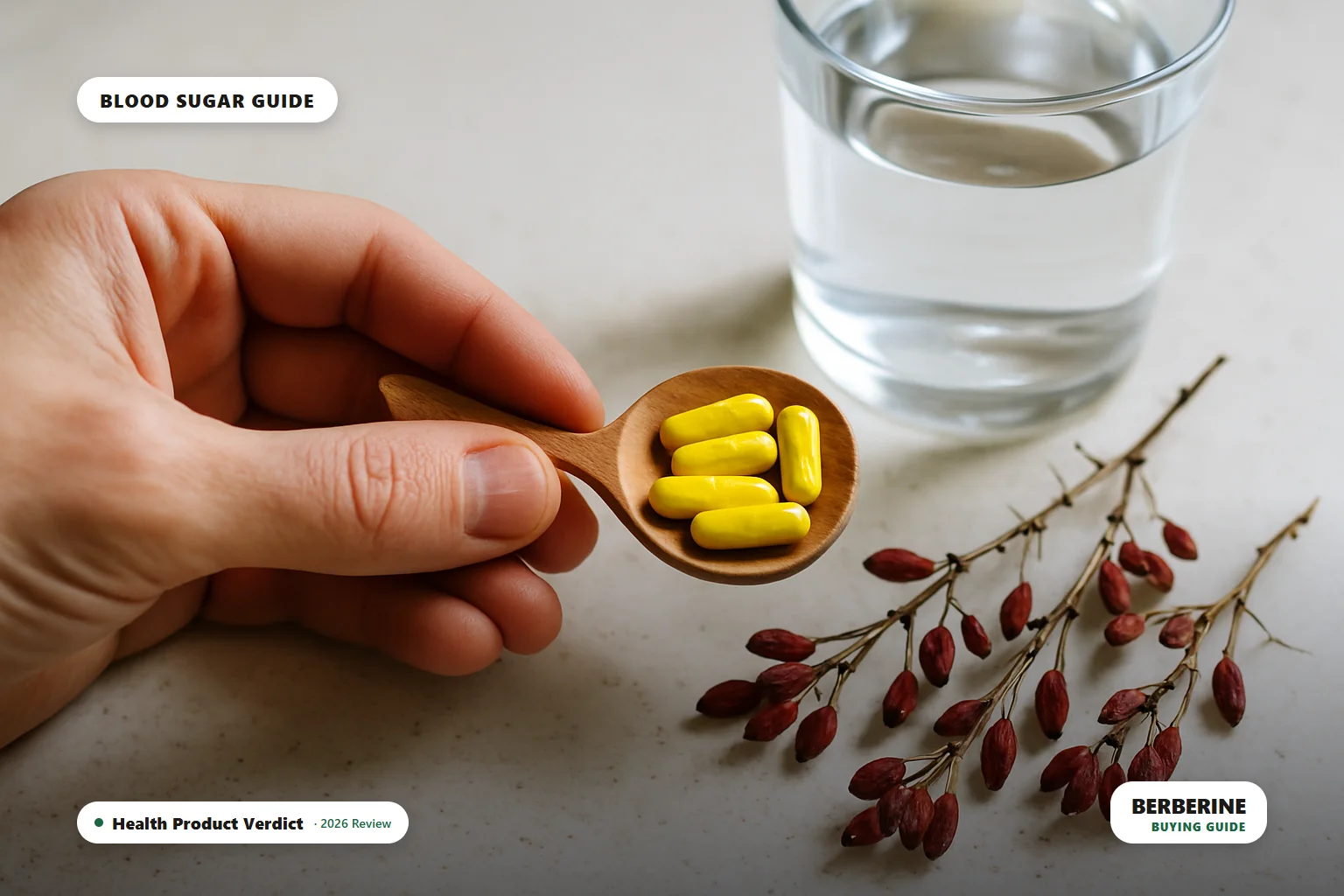
Berberine is a bitter-tasting plant compound found in several species, including barberry, goldenseal, and Oregon grape, and it has a long history in traditional Chinese and Ayurvedic medicine, where it was used for digestive and infection-related complaints long before modern researchers became interested in its effect on blood sugar. In supplement form, it’s most often marketed today for blood sugar, cholesterol, and metabolic support, which is also where most of the modern clinical research has focused.
What pulled berberine into mainstream attention wasn’t a marketing campaign, it was researchers noticing, somewhat by accident, that a compound already used for other purposes was also producing meaningful changes in glucose and lipid markers in diabetic patients. That’s part of why it has a more substantial research base than most trending supplement ingredients.
Does Berberine Actually Lower Blood Sugar? What the Research Shows
One of the most frequently cited studies, published in the peer-reviewed journal Metabolism and archived by the National Institutes of Health (NIH), followed newly-diagnosed type 2 diabetes patients taking 500 mg of berberine three times daily for 13 weeks. The results were substantial: fasting blood glucose fell from 10.63 to 6.85 mmol/L, post-meal blood glucose dropped from 19.83 to 11.05 mmol/L, and HbA1c (a 3-month average blood sugar marker) declined from 9.47% to 7.48%.
Glucose levels didn’t drop instantly. The study describes a progressive decline that reached its lowest point around week 5 and then held steady through the end of the 13-week trial, which is a useful detail for anyone expecting overnight results.
This isn’t an isolated finding. A separate 2022 review published in Frontiers in Pharmacology reached a similar conclusion, describing multiple ways berberine reduces glucose, including lowering intestinal glucose absorption and reducing post-meal blood sugar spikes.
How Berberine Is Thought to Work
Researchers have proposed several overlapping mechanisms rather than a single explanation:
- Improved insulin sensitivity, helping cells respond better to the insulin already present
- AMPK activation, an enzyme sometimes called the body’s “metabolic master switch,” involved in how cells use glucose for energy
- Reduced intestinal glucose absorption, through a mechanism similar to alpha-glucosidase inhibitor medications
- Effects on gut bacteria, an area of newer, still-developing research
Notably, more than one of these mechanisms overlaps with how metformin, a standard first-line diabetes medication, is understood to work, which is part of why berberine draws comparisons to it. That doesn’t mean the two are interchangeable, just that they act on some of the same biological pathways.
Limitations Worth Knowing About the Research
The evidence for berberine is real, but it isn’t as bulletproof as some marketing suggests. Several of the most-cited trials, including the one detailed above, are relatively small (dozens to low hundreds of participants) and were conducted in China, with less independent replication in other populations. Study duration is typically weeks to a few months, not years, so long-term safety and effectiveness data is thinner than for well-established prescription medications.
Dosing also isn’t fully standardized across studies or commercial products, and because berberine isn’t reviewed by the FDA for safety and effectiveness as a supplement, product quality and actual berberine content can vary between brands.
None of this means the evidence should be dismissed. Multiple independent research groups, not just one lab, have reported similar glucose-lowering effects using different study designs, which adds some confidence beyond any single trial. But “promising and researched” is a more accurate description than “clinically proven miracle,” and it’s worth treating the marketing language around berberine with more skepticism than the underlying science itself deserves.
Side Effects and Drug Interactions
Gastrointestinal side effects are the most common issue reported in clinical trials, showing up in roughly a third of participants in some studies: diarrhea, constipation, gas, and abdominal discomfort. These effects were generally described as transient, appearing in the first few weeks and often improving with a lower dose.
The interaction risk that matters most: because berberine lowers blood sugar, combining it with prescription diabetes medications can push glucose down too far, causing hypoglycemia. According to WebMD’s supplement database, berberine may also alter blood levels of other medications more broadly, and it isn’t recommended during pregnancy or breastfeeding, or for infants, due to a risk of a serious condition called kernicterus.
When to Talk to a Doctor First
Anyone currently taking prescription diabetes medication, blood thinners, or other regular medications should talk to a doctor before adding berberine, specifically because of the blood-sugar-lowering interaction risk described above. It’s also worth a conversation if you’re pregnant, breastfeeding, or managing a chronic liver or digestive condition, since the research in those groups is limited.
Possible Solutions Worth Considering
Berberine is one ingredient among several researched for blood sugar support, often combined with other compounds in a daily formula rather than taken in isolation.
GlucoTrust
A daily blood sugar support formula combining several researched ingredients, intended to be used alongside diet and activity changes rather than as a stand-alone fix.
Read our full GlucoTrust review for the complete breakdown.
CelluCare
Another blood sugar support formula, worth comparing against GlucoTrust on ingredients and price before deciding between the two.
Read our full CelluCare review for the complete breakdown.
FAQ
How fast can berberine lower blood sugar?
In the clinical trial with the most detailed data, glucose declined progressively and reached its lowest point around week 5 of consistent use, not immediately. Effects at that dose (500 mg three times daily) were then maintained through the rest of the 13-week study.
Is berberine as effective as metformin?
Some studies have found comparable glucose-lowering effects between berberine and metformin, and the two share some overlapping mechanisms. That said, metformin has decades more research and real-world use behind it. Berberine shouldn’t be treated as a proven substitute for prescribed medication without a doctor’s guidance.
What should you not take berberine with?
The main concern is combining it with prescription diabetes medications, since the added blood-sugar-lowering effect can push glucose too low. Berberine may also affect levels of other medications more broadly, so anyone on regular prescriptions should check with a doctor or pharmacist first.
What’s the main downside of taking berberine?
Gastrointestinal side effects are the most common complaint, reported in roughly a third of participants in some trials. Diarrhea, gas, and stomach discomfort are the most typical, and they often ease with a lower dose or after the first few weeks.
Can I take berberine every day long-term?
Most clinical trials only run for a few weeks to a few months, so long-term safety data beyond that window is limited. Anyone considering ongoing daily use should do so under a doctor’s guidance, with periodic check-ins rather than indefinite unsupervised use.
What dose of berberine did the studies use?
The most detailed clinical trial used 500 mg taken three times a day (1,500 mg total daily), with some participants reduced to 300 mg three times daily if digestive side effects were an issue. Commercial supplements vary in dose and format, so it’s worth comparing a product’s label against the dose actually used in research, rather than assuming more is automatically better.
Conclusion
Does berberine actually lower blood sugar? The published research says yes, with real, measurable reductions in fasting glucose, post-meal glucose, and HbA1c in people with type 2 diabetes. It’s genuinely one of the better-researched natural ingredients in this space, not just marketing hype, but it comes with real caveats: gastrointestinal side effects are common, the strongest studies are still relatively small, and combining it with diabetes medication needs medical supervision.
For the full picture on causes, habits, and every blood sugar support product we’ve reviewed, see our Blood Sugar Support: The Complete 2026 Guide.
Related Reading
- Blood Sugar Support: The Complete 2026 Guide
- Insulin Resistance vs. Prediabetes: What’s the Real Difference?
- How to Choose the Best Supplements: A Buyer’s Guide
This article is for informational purposes only and does not constitute medical advice. Talk to a doctor before starting berberine or any new supplement, especially if you take diabetes medication or other prescription drugs.
Berberine has gone from a niche traditional medicine compound to one of the most talked-about natural ingredients in blood sugar supplements, sometimes nicknamed “nature’s Ozempic” online. That kind of framing invites skepticism, so it’s worth asking plainly: does berberine actually lower blood sugar, or is this another supplement trend running ahead of the science?
Quick answer: yes, according to published clinical research, berberine does lower blood sugar in people with type 2 diabetes, with effects in some trials comparable to standard oral diabetes medications. The catch is that most of the strongest studies are relatively small, several were conducted in China with limited replication elsewhere, and gastrointestinal side effects are common enough to matter. It’s a genuinely researched ingredient, not a proven replacement for prescribed medication.
What Is Berberine?
Berberine is a bitter-tasting plant compound found in several species, including barberry, goldenseal, and Oregon grape, and it has a long history in traditional Chinese and Ayurvedic medicine, where it was used for digestive and infection-related complaints long before modern researchers became interested in its effect on blood sugar. In supplement form, it’s most often marketed today for blood sugar, cholesterol, and metabolic support, which is also where most of the modern clinical research has focused.
What pulled berberine into mainstream attention wasn’t a marketing campaign, it was researchers noticing, somewhat by accident, that a compound already used for other purposes was also producing meaningful changes in glucose and lipid markers in diabetic patients. That’s part of why it has a more substantial research base than most trending supplement ingredients.
Does Berberine Actually Lower Blood Sugar? What the Research Shows
One of the most frequently cited studies, published in the peer-reviewed journal Metabolism and archived by the National Institutes of Health (NIH), followed newly-diagnosed type 2 diabetes patients taking 500 mg of berberine three times daily for 13 weeks. The results were substantial: fasting blood glucose fell from 10.63 to 6.85 mmol/L, post-meal blood glucose dropped from 19.83 to 11.05 mmol/L, and HbA1c (a 3-month average blood sugar marker) declined from 9.47% to 7.48%.
Glucose levels didn’t drop instantly. The study describes a progressive decline that reached its lowest point around week 5 and then held steady through the end of the 13-week trial, which is a useful detail for anyone expecting overnight results.
This isn’t an isolated finding. A separate 2022 review published in Frontiers in Pharmacology reached a similar conclusion, describing multiple ways berberine reduces glucose, including lowering intestinal glucose absorption and reducing post-meal blood sugar spikes.
How Berberine Is Thought to Work
Researchers have proposed several overlapping mechanisms rather than a single explanation:
- Improved insulin sensitivity, helping cells respond better to the insulin already present
- AMPK activation, an enzyme sometimes called the body’s “metabolic master switch,” involved in how cells use glucose for energy
- Reduced intestinal glucose absorption, through a mechanism similar to alpha-glucosidase inhibitor medications
- Effects on gut bacteria, an area of newer, still-developing research
Notably, more than one of these mechanisms overlaps with how metformin, a standard first-line diabetes medication, is understood to work, which is part of why berberine draws comparisons to it. That doesn’t mean the two are interchangeable, just that they act on some of the same biological pathways.
Limitations Worth Knowing About the Research
The evidence for berberine is real, but it isn’t as bulletproof as some marketing suggests. Several of the most-cited trials, including the one detailed above, are relatively small (dozens to low hundreds of participants) and were conducted in China, with less independent replication in other populations. Study duration is typically weeks to a few months, not years, so long-term safety and effectiveness data is thinner than for well-established prescription medications.
Dosing also isn’t fully standardized across studies or commercial products, and because berberine isn’t reviewed by the FDA for safety and effectiveness as a supplement, product quality and actual berberine content can vary between brands.
None of this means the evidence should be dismissed. Multiple independent research groups, not just one lab, have reported similar glucose-lowering effects using different study designs, which adds some confidence beyond any single trial. But “promising and researched” is a more accurate description than “clinically proven miracle,” and it’s worth treating the marketing language around berberine with more skepticism than the underlying science itself deserves.
Side Effects and Drug Interactions
Gastrointestinal side effects are the most common issue reported in clinical trials, showing up in roughly a third of participants in some studies: diarrhea, constipation, gas, and abdominal discomfort. These effects were generally described as transient, appearing in the first few weeks and often improving with a lower dose.
The interaction risk that matters most: because berberine lowers blood sugar, combining it with prescription diabetes medications can push glucose down too far, causing hypoglycemia. According to WebMD’s supplement database, berberine may also alter blood levels of other medications more broadly, and it isn’t recommended during pregnancy or breastfeeding, or for infants, due to a risk of a serious condition called kernicterus.
When to Talk to a Doctor First
Anyone currently taking prescription diabetes medication, blood thinners, or other regular medications should talk to a doctor before adding berberine, specifically because of the blood-sugar-lowering interaction risk described above. It’s also worth a conversation if you’re pregnant, breastfeeding, or managing a chronic liver or digestive condition, since the research in those groups is limited.
Possible Solutions Worth Considering
Berberine is one ingredient among several researched for blood sugar support, often combined with other compounds in a daily formula rather than taken in isolation.
GlucoTrust
A daily blood sugar support formula combining several researched ingredients, intended to be used alongside diet and activity changes rather than as a stand-alone fix.
Read our full GlucoTrust review for the complete breakdown.
CelluCare
Another blood sugar support formula, worth comparing against GlucoTrust on ingredients and price before deciding between the two.
Read our full CelluCare review for the complete breakdown.
FAQ
How fast can berberine lower blood sugar?
In the clinical trial with the most detailed data, glucose declined progressively and reached its lowest point around week 5 of consistent use, not immediately. Effects at that dose (500 mg three times daily) were then maintained through the rest of the 13-week study.
Is berberine as effective as metformin?
Some studies have found comparable glucose-lowering effects between berberine and metformin, and the two share some overlapping mechanisms. That said, metformin has decades more research and real-world use behind it. Berberine shouldn’t be treated as a proven substitute for prescribed medication without a doctor’s guidance.
What should you not take berberine with?
The main concern is combining it with prescription diabetes medications, since the added blood-sugar-lowering effect can push glucose too low. Berberine may also affect levels of other medications more broadly, so anyone on regular prescriptions should check with a doctor or pharmacist first.
What’s the main downside of taking berberine?
Gastrointestinal side effects are the most common complaint, reported in roughly a third of participants in some trials. Diarrhea, gas, and stomach discomfort are the most typical, and they often ease with a lower dose or after the first few weeks.
Can I take berberine every day long-term?
Most clinical trials only run for a few weeks to a few months, so long-term safety data beyond that window is limited. Anyone considering ongoing daily use should do so under a doctor’s guidance, with periodic check-ins rather than indefinite unsupervised use.
What dose of berberine did the studies use?
The most detailed clinical trial used 500 mg taken three times a day (1,500 mg total daily), with some participants reduced to 300 mg three times daily if digestive side effects were an issue. Commercial supplements vary in dose and format, so it’s worth comparing a product’s label against the dose actually used in research, rather than assuming more is automatically better.
Conclusion
Does berberine actually lower blood sugar? The published research says yes, with real, measurable reductions in fasting glucose, post-meal glucose, and HbA1c in people with type 2 diabetes. It’s genuinely one of the better-researched natural ingredients in this space, not just marketing hype, but it comes with real caveats: gastrointestinal side effects are common, the strongest studies are still relatively small, and combining it with diabetes medication needs medical supervision.
For the full picture on causes, habits, and every blood sugar support product we’ve reviewed, see our Blood Sugar Support: The Complete 2026 Guide.
Related Reading
- Blood Sugar Support: The Complete 2026 Guide
- Insulin Resistance vs. Prediabetes: What’s the Real Difference?
- How to Choose the Best Supplements: A Buyer’s Guide
This article is for informational purposes only and does not constitute medical advice. Talk to a doctor before starting berberine or any new supplement, especially if you take diabetes medication or other prescription drugs.