Research and analysis by the Health Product Verdict team.
Most people never read past the front of a supplement bottle. The real story of what a product does and doesn’t tell you is usually on the back, in the ingredient panel, and it is often harder to read than it should be.
We went through the label and marketing information behind 72 health and wellness supplements we have individually reviewed on this site, all sold through direct-response affiliate channels like ClickBank, Digistore24, and BuyGoods, and checked three specific things: whether each ingredient’s exact dosage is disclosed, whether any third-party testing or certification is mentioned, and whether the formula is presented as a “proprietary blend.”
Here is what we found.
The three numbers that stood out
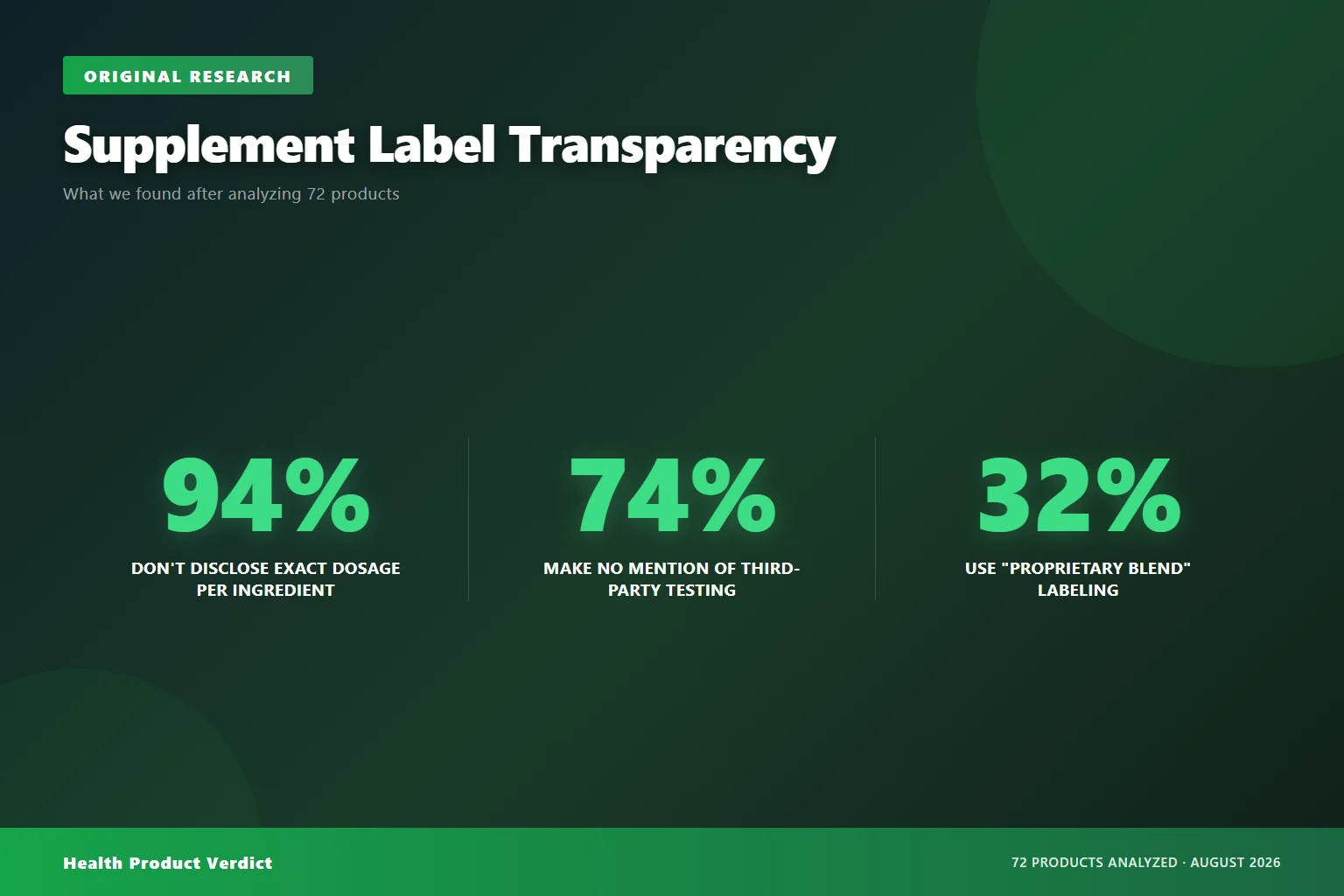
94% of the products we reviewed do not disclose an exact dosage for individual ingredients. Only 4 of the 72 products listed specific milligram, microgram, or IU amounts for two or more ingredients. The rest either listed ingredients without any amount, or grouped them into an undisclosed blend.
74% make no mention of third-party testing or certification anywhere in their marketing. No reference to NSF, USP, GMP certification, or independent lab testing appears in 53 of the 72 products we reviewed. This reflects what the product discloses about itself, not independent verification against a certifying body’s own records.
32% use “proprietary blend” labeling. 23 of 72 products describe some or all of their formula as a proprietary blend, a legal labeling practice that allows a manufacturer to disclose a blend’s total weight without breaking out how much of each individual ingredient it actually contains.
How this compares to the supplement industry overall
These three numbers are not just internal observations, they line up with a pattern that shows up in broader industry data too.
An estimated 20% of dietary supplements across the market use proprietary blend labeling, according to data from the Dietary Supplement Label Database and industry analysis published by the Council for Responsible Nutrition. That rate is far from uniform across categories: it climbs to an estimated 44% to 60% specifically among multi-ingredient pre-workout supplements, a category long associated with weaker label transparency.
Our figure of 32% sits between those two numbers, closer to the higher end. That is consistent with what we would expect from a segment of the market built primarily around direct-response marketing rather than retail shelf presence.
On testing, a 2026 review that checked 7,882 supplement brands against real NSF, USP, Informed Sport, and ConsumerLab databases found that 54% carried verified third-party testing. Our 74% figure measures something different and narrower: how often a product mentions any testing or certification in its own marketing at all. A meaningfully lower self-reported rate, in a market segment skewed toward smaller and newer brands than that broader dataset, is not a surprising result.
Why this matters
None of this means a product with a proprietary blend or no stated dosage is ineffective. Proprietary blend labeling is legal, and plenty of legitimate manufacturers use it, often citing formula protection as the reason.
What it does mean is that a shopper comparing two products side by side frequently cannot compare the actual amount of each ingredient they would be taking, because that number is not published anywhere. That is a real, measurable gap between what most supplement marketing implies about a formula and what its own label actually confirms.
We think that gap is worth naming plainly, which is the same standard we hold every individual review on this site to: report exactly what a label and sales page state, and say clearly when something isn’t disclosed rather than filling in the blank.
Methodology and limitations
This analysis covers the 72 individual product reviews published on Health Product Verdict as of August 2026, each researched directly from the product’s official sales page and label information. It is not a random sample of the supplement industry, it is a full accounting of every product we have reviewed to date, concentrated in the direct-response affiliate segment of the market (ClickBank, Digistore24, and BuyGoods listings specifically).
Health Product Verdict is an affiliate site and earns a commission on some of the products referenced in this analysis. The dosage, testing, and blend-labeling figures above reflect exactly what each product’s own label and sales page state, independent of that relationship.
If you want to see the sourcing behind any individual figure, our full set of product reviews is available to browse on the site.