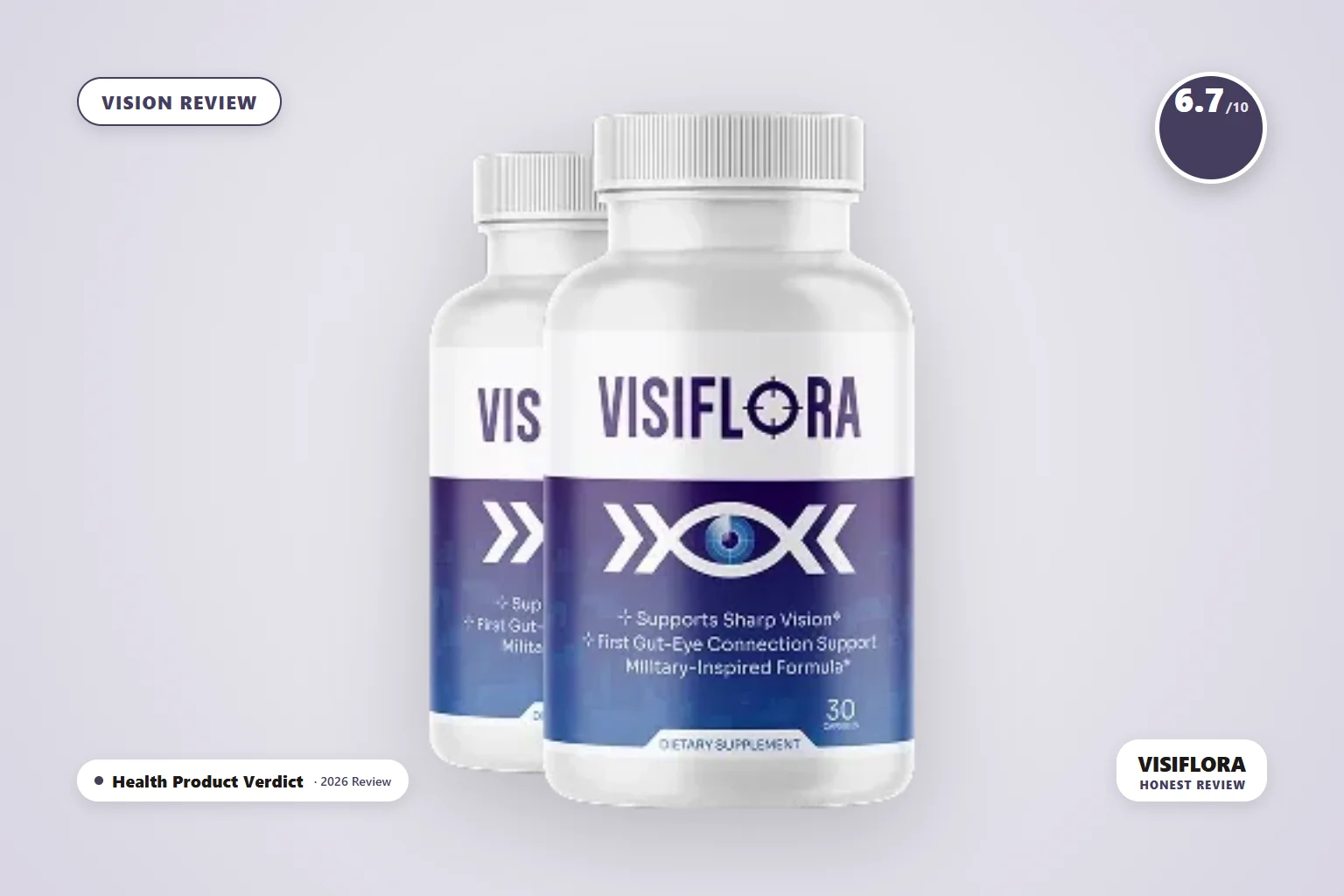
In this honest 2026 VisiFlora review, we break down the real ingredients, how they compare to the research behind eye health supplements, pricing, and whether the “gut-eye connection” story on the sales page holds up.
Tired, strained eyes after a long day on screens, plus worry about vision changes as the years go by, lead a lot of people to look at eye health supplements. VisiFlora markets itself as a “22-in-1” formula built around what it calls the gut-eye connection.
VisiFlora is a daily capsule supplement sold only through its official website, in packages starting at two bottles. The official sales page does not name a manufacturer, and doses for its 22 listed ingredients are not disclosed anywhere on the page.
What Is VisiFlora?
VisiFlora is marketed as a vision support supplement built around 22 ingredients, including several with genuine research behind eye health (lutein, zeaxanthin, astaxanthin, bilberry, zinc) alongside a group of gut-focused antioxidants (grape seed extract, rutin, quercetin, taurine, alpha lipoic acid) that the brand frames as a “gut-eye barrier complex.”
The sales page’s central claim is that “LPS toxins” from gut imbalance damage the eyes, and that neutralizing them protects vision. This gut-eye framing is not an established, mainstream mechanism in eye health research the way it’s presented here. It reads as a marketing narrative built on top of otherwise real ingredients, similar to how other supplements in this space wrap a well-chosen ingredient list in an unconventional origin story. We’d encourage judging VisiFlora on the ingredients themselves rather than the LPS narrative.
Who Is It For?
VisiFlora is aimed at adults noticing early vision changes, tired or strained eyes, or general concern about long-term eye health, who want a broad-spectrum eye supplement. For general, evidence-based information on eye health, see the National Eye Institute (NEI).
It may be worth considering for people who:
- Want a single capsule that combines AREDS2-style nutrients with additional general antioxidants
- Are comfortable buying a minimum of two bottles, since no single-bottle option is offered
Who should NOT use VisiFlora:
- Anyone who wants a brand that names its manufacturer and discloses individual ingredient doses
- Anyone with sudden vision loss, new floaters, flashes of light, or eye pain, which need an eye doctor, not a supplement
How Does VisiFlora Work?
VisiFlora’s stated approach centers on its “gut-eye” narrative: that toxins from an imbalanced gut, referred to on the sales page as LPS toxins, damage retinal structures over time, and that a combination of gut-support antioxidants and traditional eye nutrients addresses both sides of that connection.
Separate from that narrative, the formula’s core nutrients, lutein, zeaxanthin, zinc, vitamin C, vitamin E, and copper, closely track the combination studied in the AREDS2 research, a large clinical trial that found this specific combination slowed progression in people who already had intermediate age-related macular degeneration. That is a genuinely researched mechanism, though it applies to that specific condition rather than general “vision support” for everyone. VisiFlora does not disclose whether its doses of these nutrients match the AREDS2 amounts.
The additional ingredients (astaxanthin, bilberry, saffron, ginkgo biloba) each have their own smaller body of research on antioxidant activity or blood flow, discussed individually below.
Ingredients Breakdown
VisiFlora names 22 ingredients in total. Individual doses are not disclosed for any of them on the sales page. Here are the ones with the most direct relevance to eye health:
Carotenoids that concentrate in the retina and are central to the AREDS2 eye-health research on slowing macular degeneration progression.
A potent antioxidant studied for reducing oxidative stress in eye tissue; the sales page’s specific comparison to Vitamin C strength is a marketing figure we could not independently verify.
The remaining core of the AREDS2 formula alongside lutein and zeaxanthin, included here for general antioxidant and eye-tissue support.
A traditional antioxidant botanical popular in eye-support blends, with limited but suggestive research, including historical use for night vision.
Studied in small trials for supporting visual acuity, though the research base is smaller than for lutein or zeaxanthin.
Included for their association with blood flow. The sales page cites a specific “23% improvement” in retinal blood flow that we could not verify against a citable source, so we would not rely on that number.
A group of general antioxidants the brand frames as a “gut-eye barrier complex.” They are real, commonly researched antioxidant compounds, but the specific gut-eye mechanism described on the sales page is a marketing narrative rather than an established finding.
Taken as a whole, the formula’s core overlaps meaningfully with AREDS2, which is a genuine point in its favor. The tradeoff is a long ingredient list with no disclosed doses, which makes it hard to know how much of each nutrient you’re actually getting.
Pros & Cons
Pros:
- Core formula overlaps with the AREDS2 combination (lutein, zeaxanthin, zinc, vitamins C and E, copper)
- Includes several additional real antioxidants (astaxanthin, bilberry, saffron)
- Non-GMO, stimulant-free, vegan capsules
- 60-day money-back guarantee
Cons:
- No manufacturer named on the sales page
- None of the 22 ingredient doses are disclosed
- The “gut-eye” LPS-toxin narrative is marketing framing, not an established mechanism
- A specific “23% blood flow” claim could not be verified against a citable source
- No single-bottle option; the minimum purchase is two bottles ($158)
- Only available through the official website, not in retail stores
Is VisiFlora Worth It? Our VisiFlora Review Verdict
VisiFlora’s core ingredient choices are legitimately good. Building a formula around the AREDS2 combination, then adding well-known antioxidants like astaxanthin and bilberry, is a sound approach for general eye health support, and it compares favorably on paper to some other products in this category.
Where it falls short is transparency: no manufacturer is named, no doses are disclosed for any of the 22 ingredients, and the “gut-eye” storyline leans harder on narrative than on established science. The 60-day guarantee softens the risk of trying it, but the two-bottle minimum purchase is worth knowing before you buy.
Risks and Side Effects
The ingredients in VisiFlora are generally well tolerated by healthy adults. Beta-carotene (a source of vitamin A) is one ingredient worth flagging for current or former smokers, since high-dose beta-carotene has been associated with increased lung cancer risk in smokers in some research; anyone in that group should discuss this product with a doctor first.
As with any new supplement, check with a doctor first if you’re pregnant, nursing, or taking medication. Sudden vision changes, new floaters, flashes of light, or eye pain are not things to address with a supplement, they need prompt evaluation by an eye doctor.
Our Ratings
Pricing & Where to Buy
VisiFlora is sold exclusively through its official website. As of this writing, three package options are available, and each includes three free digital bonus guides:
- 2 bottles (Starter): $158 total ($79 per bottle), plus a small shipping fee
- 3 bottles (Advanced): $177 total ($59 per bottle), free US shipping
- 6 bottles (Ultimate, most popular): $294 total ($49 per bottle), free US shipping
There is no single-bottle option, so the minimum purchase is two bottles. Every order is backed by a 60-day, 100% money-back guarantee. This is a one-time purchase with no subscription mentioned on the order page.
FAQ
What is in VisiFlora?
VisiFlora lists 22 ingredients, including an AREDS2-aligned core (lutein, zeaxanthin, zinc, vitamins C and E, copper) plus additional antioxidants like astaxanthin, bilberry, and saffron. Individual doses are not disclosed.
Is the “gut-eye connection” behind VisiFlora real science?
The specific “LPS toxin” narrative on VisiFlora’s sales page is marketing framing rather than an established, mainstream mechanism in eye health research. The individual antioxidant ingredients it uses to support that story are real, but the gut-eye storyline itself should be treated skeptically.
Who makes VisiFlora?
The official sales page does not name a manufacturer.
Is there a money-back guarantee?
Yes. VisiFlora is covered by a 60-day, 100% money-back guarantee.
Where can I buy VisiFlora?
VisiFlora is only available through the official website. It is not currently listed as being sold in retail stores or on third-party marketplaces.
Our Final Verdict
VisiFlora pairs a genuinely AREDS2-aligned core (lutein, zeaxanthin, zinc, vitamins C and E, copper) with several other real antioxidants like astaxanthin and bilberry. The “gut-eye” framing is more marketing story than established science, and doses aren’t disclosed, but the ingredient list itself is a fair pick for eye health support.
6.7 / 10
→ Visit VisiFlora Official Site →🔒 Secure checkout · 60-day money-back guarantee · Affiliate disclosure
Related Reading
- Tired, Blurry Eyes? The Truth About Vision Strain and Eye Supplements
- Vision 20 Review 2026: Is It Worth Buying?
- iGenics Review 2026: What You Need to Know Before Buying
This article is for informational purposes only and is not intended as medical advice. Statements about dietary supplements have not been evaluated by the Food and Drug Administration and are not intended to diagnose, treat, cure, or prevent any disease. Consult your eye doctor or physician before starting any new supplement.