Saw palmetto shows up in more prostate supplements than almost any other single ingredient, often marketed as a natural first step before considering medication. But does saw palmetto actually work for prostate health, or is its popularity outrunning what the research actually supports? The honest answer requires looking at how the evidence has changed over time, not just citing whichever study fits the marketing.
Quick answer: the best-designed, most rigorous research, including large NIH-funded trials, has found saw palmetto performs no better than a placebo for prostate symptoms, even at triple the standard dose. Earlier, smaller studies had suggested a benefit, which is part of why saw palmetto built its reputation in the first place. It’s a low-risk supplement to try, but current high-quality evidence doesn’t support relying on it as an effective treatment.
What Is Saw Palmetto?
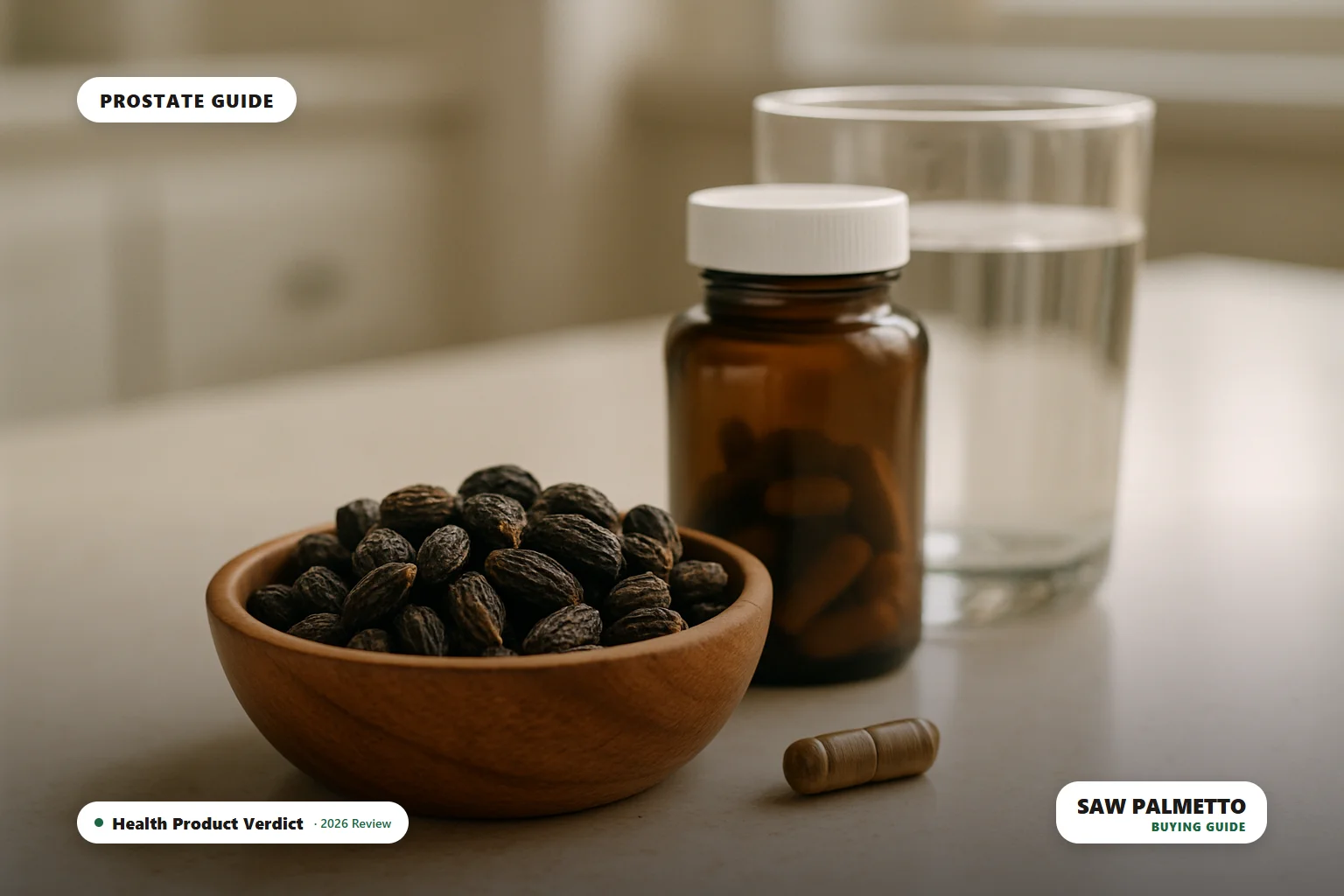
Saw palmetto is an extract from the berries of a small palm tree native to the southeastern United States, used for prostate and urinary symptoms for decades. It’s one of the most common single ingredients in prostate supplements, frequently combined with other herbs and minerals in commercial formulas.
It attracted serious research attention precisely because it wasn’t a case of an ingredient with no plausible rationale at all, researchers had real, testable hypotheses about how it might affect prostate tissue, which is exactly why it went through the kind of large, well-funded clinical trials described below rather than being dismissed outright from the start.
Does Saw Palmetto Actually Work? What the Research Shows
One of the most rigorous trials, covered by Washington University School of Medicine, followed more than 300 men aged 45 and older with moderate enlarged prostate symptoms for nearly 17 months. Researchers didn’t just test a standard dose, they escalated it over time: 320 mg daily for the first stretch, then 640 mg (double), then 960 mg (triple the standard amount) for the final period. Across urinary frequency, urgency, nighttime urination, and bladder control, saw palmetto performed no better than placebo at any dose tested.
As lead researcher Dr. Gerald Andriole Jr. put it plainly: men shouldn’t spend their money on the supplement, because it doesn’t work better than a placebo, even at three times the usual dose. According to the Cleveland Clinic, this isn’t an isolated finding either, large NIH-funded studies reached the same conclusion, and a separate year-long study in men with chronic prostatitis found no meaningful long-term symptom improvement.
Harvard Health, reviewed by Dr. Marc B. Garnick of Harvard Medical School, summarizes it directly: high-quality studies show little or no real benefit, and men are urged to talk with a doctor first, both to rule out more serious causes of their symptoms and to avoid misplaced hope in a supplement that isn’t likely to meaningfully help.
Why the Evidence Looks Mixed
Saw palmetto’s reputation didn’t come from nowhere. Earlier research, including some studies from the early 2000s, did report symptom improvement, which is part of why it became such a widely recommended natural option in the first place. But as research methodology improved, larger, better-controlled, and longer trials, the kind funded by institutions like the NIH rather than smaller industry-adjacent studies, increasingly failed to replicate those earlier positive results. This pattern, promising small studies followed by null results in larger, more rigorous ones, is common across supplement research generally, and saw palmetto for prostate symptoms is a clear example of it.
A Supplement Quality Problem Worth Knowing
Beyond the mixed effectiveness data, there’s a separate, practical issue: what’s actually in the bottle. Cleveland Clinic cites a supplement quality analysis that found actual saw palmetto content in tested products ranged from just 3% to as much as 140% of what the label claimed. Because dietary supplements face far less regulatory oversight than prescription medications, a study showing “no effect” may partly reflect inconsistent product quality on top of the ingredient’s own limited effectiveness.
Safety and Side Effects
The reassuring part: saw palmetto appears to be relatively safe. Side effects are uncommon and generally mild when they occur, headache, dizziness, and nausea are the most commonly reported. It doesn’t have major interaction problems with most medications, according to Cleveland Clinic. It’s not recommended during pregnancy or breastfeeding, and should be stopped at least two weeks before any scheduled surgery due to a potential increased bleeding risk. Trial dosing most commonly used 160 mg twice daily.
When to Talk to a Doctor Instead
Given how consistently rigorous research has failed to show a real benefit, prostate or urinary symptoms are worth bringing to a doctor rather than managing with saw palmetto alone, especially since symptoms like frequent urination, urgency, or a weak stream can have several different underlying causes, some more urgent than others, that a supplement can’t diagnose or treat. This matters even more if symptoms are new, worsening, or accompanied by pain or blood, none of which should be managed with a supplement while waiting to see if it helps.
Possible Solutions Worth Considering
Alongside medical guidance, some people look for multi-ingredient prostate formulas built around several researched compounds rather than saw palmetto alone.
ProstaVive
A daily prostate support formula intended to be used alongside medical guidance rather than as a replacement for it.
Read our full ProstaVive review for the complete breakdown.
Prosta Peak
Another prostate support formula, worth comparing against ProstaVive on ingredients and price before deciding between the two.
Read our full Prosta Peak review for the complete breakdown.
FAQ
How long does it take saw palmetto to help your prostate?
In the studies that did report some improvement, effects, when present, generally took weeks to months of consistent use to assess. But the most rigorous trial, tracking symptoms for nearly 17 months at escalating doses, found no meaningful improvement over placebo at any point in that timeline.
Is saw palmetto a good supplement for the prostate?
It’s a low-risk one, with a generally mild safety profile, but current high-quality evidence doesn’t support it as an effective treatment for prostate symptoms. It shouldn’t be relied on in place of a proper medical evaluation, especially for new or worsening symptoms.
What happens if you take saw palmetto every day?
For most people, daily use appears to be well tolerated, with mild side effects like headache, dizziness, or nausea in some cases. It doesn’t have major medication interactions for most people, but should be stopped two weeks before surgery due to a possible bleeding risk, and isn’t recommended during pregnancy or breastfeeding.
What is the fastest way to shrink an enlarged prostate?
This isn’t something a supplement, including saw palmetto, has been shown to reliably do. Medical treatments for an enlarged prostate, ranging from prescription medication to procedures, are evaluated and prescribed by a doctor based on symptom severity, and are the appropriate path for anyone looking for meaningful, timely improvement rather than a general wellness supplement.
Why did saw palmetto get such a strong reputation if it doesn’t work?
Earlier, smaller studies did report benefits, and that research shaped its early reputation before larger, more rigorous, NIH-funded trials became available. As study quality and size improved, the positive results didn’t hold up, a pattern that shows up across supplement research generally, not something unique to saw palmetto.
Do dentists or urologists recommend saw palmetto?
Most urologists don’t actively recommend it as a first-line option given how consistently rigorous, large-scale trials have failed to show a benefit over placebo. Given its mild safety profile, some may not object to a patient trying it, but generally alongside, not instead of, an actual medical evaluation of the underlying symptoms.
Conclusion
Does saw palmetto actually work for prostate health? The best available research says no, not meaningfully better than placebo, even at triple the standard dose in a rigorous, nearly 17-month trial. It’s reasonably safe to try, but it shouldn’t replace a proper medical evaluation for prostate or urinary symptoms, and its popularity says more about how supplement reputations form than about what current, high-quality evidence actually shows.
For the full picture on causes, habits, and every prostate support product we’ve reviewed, see our Prostate Health: The Complete Guide.
Related Reading
- Prostate Health: The Complete Guide
- Frequent Nighttime Urination: Why It Happens and What Might Help
- How to Choose the Best Supplements: A Buyer’s Guide
This article is for informational purposes only and does not constitute medical advice. Consult a healthcare professional for diagnosis and treatment of prostate or urinary symptoms.